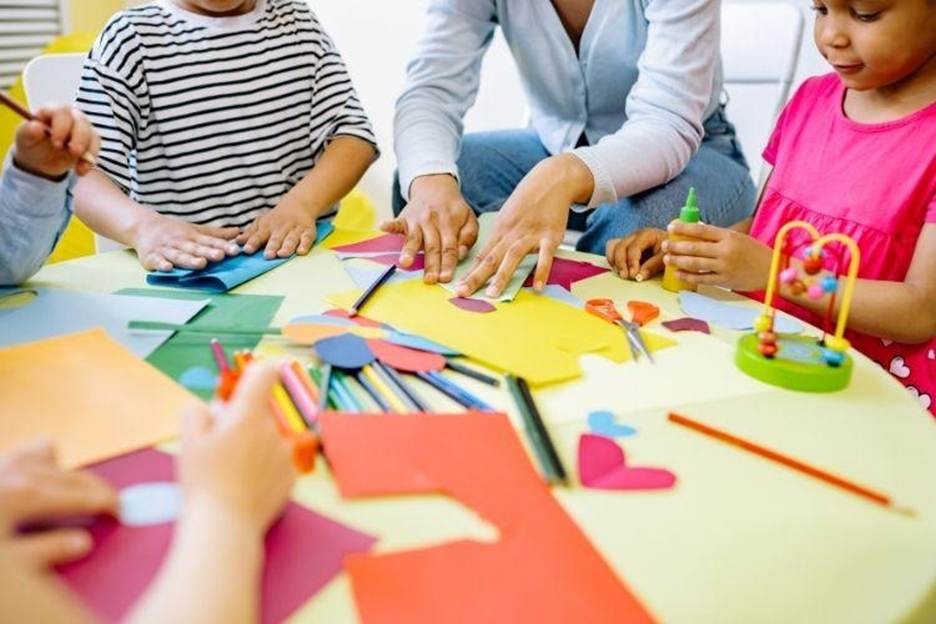
Give a child some cardboard, tape, craft sticks, and an idea, and something interesting happens. The finished creation might be a wobbly bridge, a miniature house, or an object no adult could easily name. Yet the object is only part of the story.
Hands-on making asks children to turn an idea into something real. They choose materials, judge size and shape, work out what fits, change course when something fails, and decide when the job is finished. A simple afternoon project can involve physical, cognitive, creative, and social skills at once.
Making Turns Ideas Into Problems Kids Can Solve
A child building a cardboard castle starts with a picture in their head. Then reality intervenes. The walls fall over. The doorway is too small. The tape will not hold. Suddenly, there is a problem to investigate.
Open-ended projects work well because there is rarely one correct route to the result. Children can compare options, make adjustments, and learn from what happened the first time.
For families who want to keep that curiosity going beyond the craft table, children’s learning resources from Tuttle Twins include books and activities designed around critical thinking and real-world ideas. The same broad principle applies: children benefit when they have something meaningful to question or work through.
Their Hands and Brains Work Together
Cutting paper, threading beads, folding card, pinching clay, and tying knots all require controlled movement. These tasks give children practice coordinating what they see with what their hands do.
Research has found associations between fine-motor or visual-motor skills and later academic performance. That does not prove that crafting raises grades. It does show that motor development and learning are connected areas of childhood development.
Making also physically introduces spatial thinking. Construction, folding, measuring, and fitting objects together expose children to distance, rotation, symmetry, size, and proportion. A 2020 meta-analysis found that early spatial-skills training methods, including hands-on exploration, could improve young children’s spatial abilities.
They Practice Planning Without Calling It Planning
Most projects create a sequence. Decide what to make. Gather materials. Work out where to begin. Hold one part in place while attaching another. Remember what still needs doing.
Those demands overlap with executive-function skills. The Center on the Developing Child at Harvard describes executive function and self-regulation in terms of working memory, mental flexibility, and self-control. It also notes that children develop these capacities through interaction and practice.
A child may have to remember a plan while adapting it because the material behaves differently than expected. That puts attention, memory, and flexible thinking to work at once.
Mistakes Become Useful Information
Adults often see a collapsed model or crooked drawing as something to fix. For a child, it can be feedback.
Perhaps the paper was too thin. The base needed to be wider. The glue needed longer to dry. When children have room to notice the problem and try again, mistakes become information rather than a verdict on whether they are “good” at making things.
Persistence is easier to understand when the consequences are visible. “Try again” is abstract. Watching a tower stand after changing its base is evidence.
The challenge should still suit the child’s age and abilities. Harvard’s guidance on executive-function activities similarly recommends challenges that stretch children without becoming too difficult to manage.
Creativity Is a Series of Decisions
Creativity is sometimes treated as a talent children either have or do not. In everyday making, it is much more practical.
What color should this be? Could that jar become a lantern? What could replace the missing wheel? Does the model need another support? Open-ended projects can involve dozens of small decisions.
The National Association for the Education of Young Children recommends a mix of self-directed play, guided play, and direct instruction, with opportunities for children to choose materials and approaches.
Choice gives children ownership. Copying an adult example can teach technique, while a project with room for interpretation asks a child to contribute ideas. Both can be worthwhile, but they exercise different skills.
They See That Effort Changes an Outcome
Hands-on projects make cause and effect visible. Press harder and clay changes shape. Add weight and a structure bends. Sand a rough edge and it becomes smoother.
Children can see their actions changing the result. That can support a useful sense of agency: “I did something, and it made a difference.”
The American Academy of Pediatrics has emphasized the developmental role of play, linking it with cognitive, language, social-emotional, and self-regulation skills. One of its simplest recommendations is: “Play with your child every day.”
How Adults Can Help Without Taking Over
The quickest way to make a child’s project look better is often for an adult to do more of it. That can also remove much of the useful thinking.
Instead of correcting every problem, ask what the child notices. “What could make this stronger?” gives them more to work with than “Put another piece of tape there.” If they are stuck, offer a couple of possible materials rather than rebuilding the project yourself.
Safety is the clear exception. Adults should supervise tools and materials according to the child’s age and ability.
It also helps to ask about the process rather than judging the result. What was the hardest part? What changed from the first idea? What would you do differently next time? These questions show that thinking and adapting count too.
Conclusion
When children make things with their hands, they are doing far more than producing something for the refrigerator door.
They are coordinating movements, making choices, testing physical ideas, planning ahead, working through setbacks, and seeing how effort changes an outcome. Depending on the project, they may also practice spatial reasoning, communication, cooperation, or simple mathematical thinking.
None of this requires expensive kits. Cardboard, paper, clay, fabric scraps, blocks, and recycled containers can all become raw material for serious thinking.
The most useful thing adults can provide is not a picture-perfect example. It is time, suitable materials, a safe space to experiment, and permission for the first attempt to be imperfect. The object may eventually be recycled or forgotten. The habits practiced while making it can last much longer.