When you’re getting ready to sell your home, the outside can become an easy place to overspend. Fresh sod, a new patio, upgraded fencing, elaborate plantings, and a brand-new deck may all make the property look better. But looking better and producing a financial return aren’t always the same thing.
For sellers, the goal is usually simpler: remove the outdoor problems that could make buyers hesitate, improve the home’s first impression, and spend larger amounts only where the improvement is likely to influence the sale.
That approach makes particular sense in 2026. An earlier forecast from Harvard University’s Joint Center for Housing Studies projected that annual growth in renovation and repair spending would ease to about 1.6% by the end of 2026. Homeowners are still spending heavily, but slower growth gives sellers another reason to be selective rather than tackling every project on the wish list.
So, which outdoor improvements are worth making before you list? Start with maintenance and inexpensive curb-appeal work. Then consider larger projects based on their condition, cost, neighborhood expectations, and likely return.
Start With High-Priority Outdoor Fixes
Before pricing decks, patios, or outdoor kitchens, take care of the basics.
Buyers see the exterior before they see the kitchen, bedrooms, or living room. Overgrown shrubs, stained siding, peeling trim, dead grass, damaged steps, and broken fixtures can create an immediate impression that the property hasn’t been maintained.
Many of these problems are relatively inexpensive to address, especially compared with a major renovation.
Clean Up Existing Landscaping
One of the strongest cases for pre-sale outdoor spending is also one of the simplest: maintain what you already have.
The 2023 Remodeling Impact Report from the National Association of REALTORS® and National Association of Landscape Professionals estimated that standard lawn care costing $415 could add about $900 in value. That’s a 217% cost recovery.
The same report estimated:
-
Landscape maintenance could recover about 104% of its cost.
-
A broader landscaping upgrade could recover approximately 100%.
-
Tree care could recover about 87%.
That doesn’t mean every dollar spent on plants will automatically come back at closing. It does show why basic yard maintenance can be a better pre-sale bet than expensive construction.
Mow and edge the lawn. Remove weeds. Trim shrubs away from walkways and windows. Prune obviously overgrown branches. Rake leaves, remove dead plants, and refresh worn mulch.
These jobs don’t have to make the yard look elaborate. They need to make it look cared for.
Repair Thin, Patchy, or Neglected Lawn Areas
A full lawn replacement may be unnecessary if most of the grass is healthy. Instead, look for conspicuous trouble spots near the driveway, walkway, patio, or front entrance.
Depending on the season and your timeline, that might mean seeding, laying a small amount of sod, controlling weeds, or simply keeping the existing grass cut and watered before listing photos.
The front yard deserves particular attention because it’s often visible in online listing photos. A relatively small bare patch can become surprisingly noticeable in a wide exterior shot.
If you’re already preparing a home for sale, think of outdoor cleanup as part of the same presentation process as decluttering and staging inside. The goal isn’t to create someone else’s dream yard. It’s to make it easier for prospective buyers to see the property as well maintained and move-in ready.
Wash Exterior Surfaces
Dirt accumulates gradually, which makes it easy for homeowners to stop noticing it.
Buyers won’t have that familiarity.
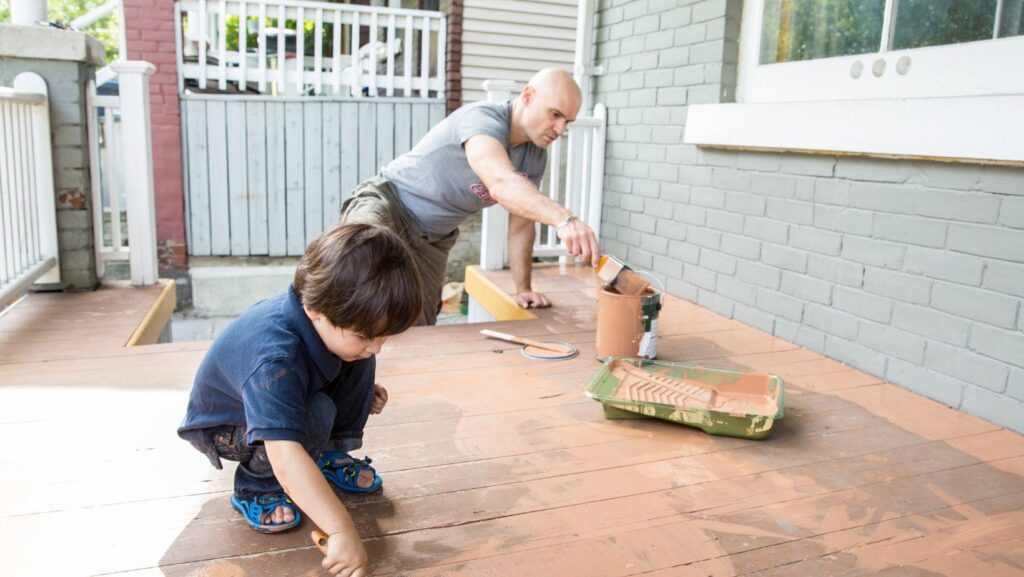
Look closely at siding, brick, concrete, porch floors, decks, walkways, fences, garage doors, and outdoor furniture. Pressure washing or soft washing, when appropriate for the material, can make existing surfaces look substantially better without replacing them.
Pay particular attention to the route buyers will follow from the curb to the front door.
A cleaner driveway, walkway, porch, and entrance can do more for the first impression than an expensive improvement hidden behind the house.
Touch Up Peeling or Faded Paint
You probably don’t need to repaint every exterior surface. Concentrate on areas where deterioration is obvious.
Potential targets include:
-
Front doors
-
Porch railings
-
Exterior trim
-
Shutters
-
Fence gates
-
Deck railings
-
Mailboxes
-
Small areas with peeling or chipped paint
Matching existing paint can keep costs low while removing visual distractions.
The front door deserves extra attention because buyers often spend a minute or two there while an agent opens the lockbox. That gives them plenty of time to notice peeling paint, cobwebs, damaged hardware, or dirty trim.
Fix Obvious Exterior Defects
Cosmetic improvements shouldn’t come before repairs that could make buyers question the home’s condition.
Walk around the property and look for broken fence boards, loose railings, cracked steps, missing pavers, unstable handrails, damaged gates, clogged gutters, leaking outdoor faucets, and lights that don’t work.
A buyer may not know what a loose railing costs to repair. They may simply wonder what else has been neglected.
That uncertainty can become more expensive than the repair itself.
Add Low-Cost Features Buyers Commonly Want
Once the property is clean and repaired, a few smaller additions may improve presentation without requiring a large construction budget.
Upgrade Exterior Lighting Where Needed
Outdoor lighting can make an entrance more inviting while also serving a practical purpose.
Research from the National Association of Home Builders found that 87% of buyers rated exterior lighting as either essential or desirable.
That doesn’t mean you need an elaborate lighting system.
Start with existing fixtures. Replace burned-out bulbs, clean dirty glass, straighten fixtures, and replace visibly dated or damaged units where the cost is reasonable.
Simple pathway or porch lighting may also be worthwhile when entrances are unusually dark.
Houzz’s 2026 outdoor remodeling research found that among homeowners undertaking outdoor lighting projects, 80% incorporated lighting for planted areas. That suggests buyers may be accustomed to seeing outdoor lighting treated as part of the yard rather than only as a fixture beside the front door.
Add Simple, Low-Maintenance Plants
Color can help an entrance photograph well, but don’t turn a pre-sale project into a major gardening commitment.
In Houzz’s 2026 research, 82% of homeowners renovating their outdoor areas selected flowering plants, while 73% chose low-maintenance plants.
For sellers, the second figure may be especially useful.
Buyers can admire flowers while still wondering how much work they’ll require. A few hardy plants in clean beds or containers can provide color without making the yard look labor intensive.
Consider Larger Outdoor Projects More Carefully
Once you move from cleanup and maintenance into construction, the financial equation changes.
A project can be desirable without returning its entire cost. That’s why larger improvements should usually be evaluated based on both resale value and whether the property is missing something buyers in that market expect.
Patios Can Offer Value, but Don’t Automatically Build One
Patios are widely desirable. According to the NAHB’s buyer-preference research, 82% of buyers rated a patio as essential or desirable.
The NAR/NALP outdoor remodeling report also estimated approximately 95% cost recovery for a new patio.
Those figures make patios worth considering, particularly if the backyard currently has no usable sitting area.
Still, spending thousands of dollars immediately before listing isn’t automatically justified. If your home already has a functional porch, deck, or small paved area, improving the existing space may make more financial sense than building another one.
Clean it, repair damaged sections, arrange simple outdoor furniture, and let buyers see how the area can be used.
Decks Can Be Valuable Without Fully Paying for Themselves
Decks illustrate the difference between buyer appeal and investment return.
The 2024 Cost vs. Value Report estimated that a wood deck addition costing $17,615 would add $14,596 in resale value, or about 83% of its cost.
For a composite deck, the estimated numbers were $24,206 in cost and $16,498 in resale value, equal to roughly 68% recovered.
The NAR/NALP report produced a somewhat higher estimate for wood decks, at 89% cost recovery, but neither source suggests sellers should assume they’ll recover every dollar.
If you already have a deck that’s dirty, weathered, or mildly damaged, repairs and cleaning may be worthwhile. Building a new $15,000-plus deck immediately before selling requires a much stronger reason.
Ask whether comparable homes commonly have decks and whether your property feels noticeably deficient without one.
Let the Local Market Guide Some Decisions
National ROI reports are useful benchmarks, but houses compete locally.
An improvement that feels normal in one neighborhood could be considered unusually elaborate in another. Climate matters. Lot size matters. Local price points matter. The expectations of likely buyers matter.
A swimming pool, privacy fence, covered patio, outdoor kitchen, or screened porch may carry very different weight depending on where the home is located.
Fencing Depends Heavily on the Buyer Pool
A new fence can appeal to families with children, dog owners, and buyers who value backyard privacy. But fencing is highly property-specific.
Replacing a few damaged boards or repairing a gate makes sense because you’re correcting visible deterioration.
Installing an entirely new perimeter fence just before listing is harder to justify unless fences are standard among comparable homes or the property has an obvious privacy issue.
There’s also personal preference involved. One buyer may value a tall privacy fence while another prefers an open yard.
Outdoor Kitchens and Fireplaces Need Context
Premium outdoor amenities can be associated with higher sale prices, but sellers should be cautious about assuming causation.
Zillow’s 2026 analysis found that homes mentioning an outdoor kitchen sold for 4.4% more than expected. Outdoor showers were associated with a 4.3% premium, while outdoor fireplaces were associated with 2.8%.
Those findings show that certain outdoor amenities can be attractive features. They don’t mean installing an outdoor kitchen shortly before listing will produce an automatic 4.4% return.
Homes with those amenities may differ from homes without them in other ways, including location, price tier, lot quality, or overall condition.
If you already have one of these features, clean it, repair it, and feature it prominently in listing photos. Installing one purely for resale is a much bigger gamble.
Projects Sellers May Be Better Off Skipping
Some outdoor work is better left to the next owner.
Be especially careful with projects that are expensive, highly personalized, difficult to finish before listing, or unlikely to solve a visible problem.
That may include:
-
Elaborate garden installations
-
Large custom water features
-
High-end outdoor kitchens
-
Major retaining-wall projects that aren’t needed for repair
-
Expensive specialty fencing
-
Oversized decks
-
Extensive hardscaping
-
Luxury structures that exceed neighborhood norms
Houzz reported that 57% of homeowners upgrading lawn areas incorporated hardscaping and 48% incorporated garden beds. Those may be worthwhile improvements for someone planning to enjoy the home for years. A seller preparing to move soon has a different calculation.
You’re investing for a sale, not for several summers of personal use.
Before approving a large project, ask three questions: Will buyers notice that the property currently lacks this feature? Is the improvement common among competing homes? And is there strong evidence that the expected price benefit can justify the cost?
If the answer to all three isn’t convincing, preserving your cash may be the better choice.
What If You Need to Sell Quickly?
Your selling timeline should affect your outdoor budget.
A homeowner planning to list six months from now may have time to establish grass, grow new plantings, repair a deck, and collect several contractor estimates. Someone selling in a matter of weeks has fewer opportunities to recover from delays or cost overruns.
In faster-sale situations, prioritize repairs, cleaning, mowing, trimming, paint touch-ups, and anything that improves listing photos immediately.
Owners considering alternatives to a traditional listing may also weigh whether improvements are worth doing at all. For example, sellers researching cash home sales in Jackson County may be comparing a quicker as-is sale with the time and expense required to prepare a property for the open market.
The right choice depends on the home’s condition, selling timeline, expected offers, and cost of the proposed work.
Spending $1,000 to address obvious exterior problems before a conventional listing can be very different from spending $20,000 on a new outdoor feature when you’re trying to sell quickly.
A Simple Priority Order for Outdoor Improvements
If you’re unsure where to put your money, work from problems to presentation and from low cost to high cost.
A practical order is:
-
Repair safety or maintenance problems. Fix broken steps, loose rails, damaged fencing, leaks, and other conspicuous defects.
-
Clean the property. Wash dirty exterior surfaces, patios, porches, walkways, and driveways where appropriate.
-
Tidy the yard. Mow, edge, weed, prune, remove debris, and refresh mulch.
-
Improve worn finishes. Touch up peeling trim, railings, doors, or other prominent painted surfaces.
-
Check lighting. Make existing exterior fixtures clean, functional, and presentable.
-
Add small finishing touches. Consider simple plants or inexpensive updates around the entry.
-
Evaluate larger construction separately. Compare the estimated cost with local buyer expectations and likely resale value before building anything new.
That sequence helps prevent a common mistake: spending heavily on a new feature while inexpensive maintenance problems remain visible around it.
Make the Outside Look Cared For, Not Overbuilt
The highest-return outdoor improvements before a sale are often less exciting than sellers expect.
Lawn care, routine landscaping, exterior cleaning, paint touch-ups, working lights, and repairs to obvious defects can improve curb appeal without tying up large amounts of money. Research from NAR and NALP is particularly encouraging for basic lawn care and maintenance, with estimated cost recoveries of 217% and 104%, respectively.
Larger improvements deserve more scrutiny. Patios and decks can add value, but published return estimates show that sellers may recover only part of what they spend. Premium features such as outdoor kitchens can make a property more appealing, yet installing one solely to chase a higher selling price introduces substantial risk.
Start by fixing what’s broken. Clean what’s dirty. Maintain what’s overgrown. Then look at your local competition before committing to anything expensive.
A buyer doesn’t necessarily need to see a brand-new backyard. They need to see an outdoor area that appears functional, attractive, and properly maintained—and one they can comfortably make their own.